
Every public works director in California, Nevada & Arizona knows the problem. The road looks fine this year. It looks a little worn next year. By year four or five, it’s showing serious cracking and the budget request for repairs gets kicked to the following fiscal year. By year seven, there’s a pothole problem. By year ten, the road needs reconstruction at a cost that is ten times what proactive maintenance would have cost five years earlier.
This is the deferred maintenance cycle, and it’s one of the most expensive patterns in municipal infrastructure management. It’s also entirely preventable.
A well-structured preventive pavement maintenance program doesn’t just fix roads faster. It changes the math on what road maintenance costs over the full lifecycle of the infrastructure. The equipment to run that program — Cimline crack sealers, mastic melters, and DuraPatcher spray injection units — is already available and already proven in municipal fleets across the state. The program itself is the piece that most agencies are missing.
Here’s what a functioning preventive maintenance program looks like, what it costs versus reactive repair, and how to build one with the right equipment for each stage of the pavement lifecycle.
The Core Financial Case
The pavement maintenance cost ratio that engineers and public works professionals consistently cite is straightforward: one dollar spent on preventive maintenance prevents six to ten dollars in future repair or reconstruction costs. That ratio is documented in Federal Highway Administration research, California Department of Transportation guidance, and decades of municipal fleet data.
The reason the ratio is so large is base layer damage. Asphalt is a surface treatment over a compacted base. When water infiltrates a crack and reaches the base, it softens the material, causes differential settlement, and triggers the failure cascade that produces potholes and eventually requires full-depth reconstruction. The crack that costs a few dollars to seal prevents the base damage that costs thousands to repair.
When a municipality defers crack sealing because the budget is tight, it doesn’t save money. It borrows against future capital budgets at a very unfavorable rate.
The Pavement Condition Window: When Each Method Works
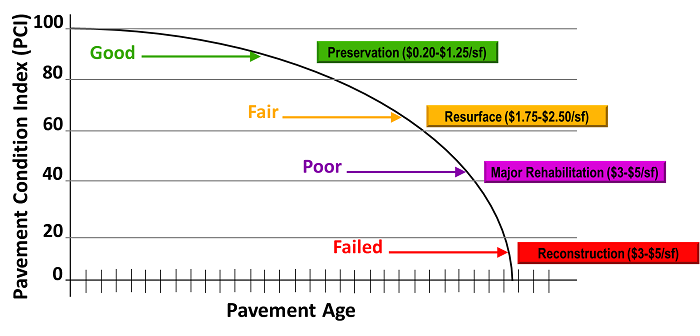
Understanding preventive maintenance timing requires understanding where a road is on the pavement condition index (PCI) — the standard 0 to 100 scale used to assess road surface quality. The right maintenance method changes significantly depending on where a road falls on that scale.
PCI 70 to 100: Crack Sealing Window
Roads in this range are structurally sound but beginning to show surface cracks. This is the optimal window for crack sealing with the Cimline M-Series. The base is intact, the crack edges are clean, and sealant can bond properly to stop water infiltration. Treatment cost is low, and the investment extends road life by five to ten additional years in this condition band. Adding crack routing with the Cimline R3 router before sealing produces even longer repair intervals.
PCI 55 to 70: Mastic and Joint Repair Window
Roads in this range show more advanced cracking, often at joints and seam lines, and may have utility cuts or other disruptions that have created high-stress transition edges. Mastic repair with the Cimline ME-Series addresses these joint locations more effectively than standard crack sealant, providing the structural body needed where differential movement and concentrated traffic loading are already stressing the pavement. Crack sealing continues for standard crack patterns in this PCI range.
PCI 35 to 55: Patching and Stabilization Window
Roads in this range have moved from preventive territory into corrective maintenance. Pothole patching with the Cimline DuraPatcher is the appropriate tool here — spray injection repairs address the surface failures quickly and permanently, and they stop individual failures from spreading into larger base failures. At this stage, the goal is to arrest deterioration and preserve enough pavement structure to defer reconstruction.
PCI Below 35: Reconstruction Zone
Below PCI 35, the cost-benefit analysis of surface repair largely collapses. The base is typically compromised, and surface treatments are temporary fixes on a structure that needs full-depth replacement. This is where deferred maintenance programs end up, and where the real budget damage is done. No amount of crack sealing or patching equipment gets you out of a PCI 25 road at a reasonable cost. The only path out is reconstruction.
The goal of a preventive program is to keep roads in the PCI 70 to 100 band through regular crack sealing, address joint deterioration in the 55 to 70 band before it becomes structural failure, and use DuraPatcher patching as a corrective backstop that prevents PCI 40 roads from sliding into reconstruction territory.
Building the Program: Equipment, Scheduling, and Workflow
Step 1: Inventory and Condition Assessment
A functional program starts with knowing what you have. A basic PCI survey of the road network — even a windshield survey supplemented by crew observation — gives the baseline data needed to prioritize work. Roads in the crack sealing window get scheduled first, because that investment has the highest return. Roads in the patching zone get addressed on a repair priority basis. Roads approaching reconstruction territory get escalated to the capital budget conversation.
Step 2: Annual Crack Sealing Routes
Crack sealing should be scheduled as a seasonal program, typically in spring or fall when pavement temperatures support good sealant adhesion. With a Cimline M-Series melter, a two-person crew can cover significant mileage per day depending on crack density. Routing with the R3 before sealing adds time to the process but meaningfully extends repair intervals, which reduces the total number of re-seal events on any given segment over the program’s lifetime.
Municipalities that establish annual crack sealing contracts or dedicated in-house programs typically find that they’re treating the same roads less frequently over time, because the crack sealing is actually holding. That’s the compound return on prevention.
Step 3: Mastic Joint Repair
Utility cuts, bridge joints, and longitudinal seams should be identified during the condition assessment and scheduled for mastic repair with the ME-Series. These locations are predictable — every utility excavation creates a joint that will need proper treatment, and every bridge deck has expansion joints that need periodic resealing. Building mastic repair into the program as a standard workflow, rather than treating every utility cut edge as a one-off reactive call, normalizes the maintenance and reduces the cost per repair through crew efficiency.
Step 4: DuraPatcher Patrol Program
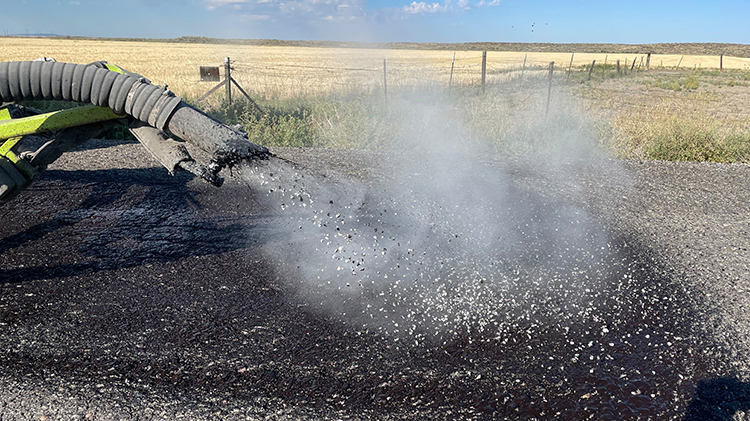
Pothole patching with the DuraPatcher operates as an ongoing reactive program alongside the preventive work. The spray injection method is fast enough that a single operator in a P5 unit can cover a significant number of repairs per day, which makes it practical to run daily or weekly patching patrols that keep the road network’s worst spots addressed before complaints and safety concerns accumulate.
The DuraPatcher patrol also creates a feedback loop for the preventive program. High patch density on a specific road segment is a signal that the road has moved out of crack sealing territory and into the PCI range where reconstruction planning needs to begin.
The Total Cost Comparison
Consider two approaches to managing 50 miles of residential streets over a 20-year period.
Reactive approach: No crack sealing. Pothole patching as complaints come in with traditional methods. Eventual reconstruction at roughly $1 million per lane mile when roads deteriorate below acceptable condition. Over 20 years, a significant portion of those 50 miles will cycle through reconstruction.
Preventive approach: Annual crack sealing program covering the road network on a rotating 5-year cycle. DuraPatcher patrol program for reactive patching. Mastic treatment of utility cuts and joint locations. Construction is deferred significantly on roads that receive consistent preventive treatment, and when reconstruction does occur, it happens later in the pavement lifecycle.
The equipment investment for a Cimline crack sealing and patching program is a fraction of the cost of a single lane mile reconstruction. The operating cost per linear foot of crack sealed is a fraction of the cost per square foot of pothole patched. Every year of effective preventive maintenance deferred at the reconstruction end of the lifecycle represents real capital budget savings.
How Haaker Underground Supports Your Program
Haaker Underground has equipped municipal public works departments, contractors, and maintenance operations across California, Nevada, and Arizona with the full Cimline lineup. We understand the budget cycles, crew capacity constraints, and political realities that municipal maintenance programs operate within.
We can help you spec the right combination of M-Series crack sealing capacity, ME-Series mastic capability, and DuraPatcher patching configuration for your road network and crew size. We can also connect you with Cimline’s support resources for program planning and operator training.
The program design work is part of the conversation — not something you have to figure out on your own after the equipment arrives.
View Cimline Crack Sealing Equipment | Explore the Full Cimline Lineup | Contact Our Team
Frequently Asked Questions
How much money does preventive pavement maintenance save?
Research from the Federal Highway Administration and state transportation agencies consistently shows that one dollar spent on preventive pavement maintenance prevents six to ten dollars in future repair or reconstruction costs. The savings come primarily from protecting the base layer beneath the asphalt surface — once the base fails due to water infiltration through unsealed cracks, the cost of repair escalates sharply from surface treatment to full-depth reconstruction.
What is a pavement condition index (PCI)?
The pavement condition index (PCI) is a standard 0 to 100 scale used to assess the structural and surface condition of road pavement. A PCI of 100 represents a new, undamaged surface. Roads above PCI 70 are good candidates for preventive crack sealing. Roads between 55 and 70 benefit from mastic joint repair and continued crack sealing. Roads below 55 are typically in the corrective maintenance or reconstruction planning range. Regular PCI surveys are the foundation of any effective pavement management program.
When is the best time of year to crack seal roads in California?
In California, Nevada & Arizona, crack sealing is most effective in spring and fall, when pavement temperatures are moderate and cracks are at a mid-point between their maximum winter opening and summer compression. Sealant applied when cracks are at their widest (cold weather) may experience compression failure when temperatures rise. Sealant applied in peak summer heat may not penetrate properly. Spring and fall conditions produce the best sealant adhesion and the longest repair intervals.
What equipment do I need to run a preventive pavement maintenance program?
A complete municipal preventive maintenance program typically includes a crack router (Cimline R3) for routing before sealing, a crack sealing melter (Cimline M-Series) sized to the daily work volume, a mastic melter (Cimline ME-Series) for joint and utility cut repairs, and a spray injection pothole patcher (Cimline DuraPatcher) for corrective patching. Haaker Underground can help match the right configuration of each unit to your road network size, crew capacity, and annual maintenance budget.
How do I start a preventive pavement maintenance program with limited budget?
Start with a basic condition assessment to identify the roads in your network that are still in the crack sealing window — these have the highest return on treatment investment. A single Cimline M-Series crack sealer represents a manageable capital investment that can be justified against the maintenance cost savings on even a modest road network. Build from there by adding patching and mastic capability as the program matures. Haaker Underground can help structure an equipment plan that fits a phased budget approach.
Haaker Underground serves municipalities, contractors, and industrial operators across California, Nevada, and Arizona with the full Cimline pavement maintenance equipment lineup. Nobody works harder for you.