
If you manage road maintenance for a municipality, county, or private property portfolio, you’ve faced this question more times than you can count: is this crack something you seal, or has it already turned into something you need to patch? The answer matters because using the wrong method at the wrong stage of pavement deterioration wastes money, produces a repair that won’t last, and accelerates the cycle of pavement damage you’re trying to stop.
Crack sealing and pothole patching are both legitimate pavement maintenance tools. But they work at different points in the pavement lifecycle and solve different problems. Understanding which method applies to which condition gives you a smarter maintenance program, a longer-lasting road, and a better return on your equipment investment.
Here’s how the two methods compare and how to know which one your crew should be reaching for on any given job.
What Is Crack Sealing?
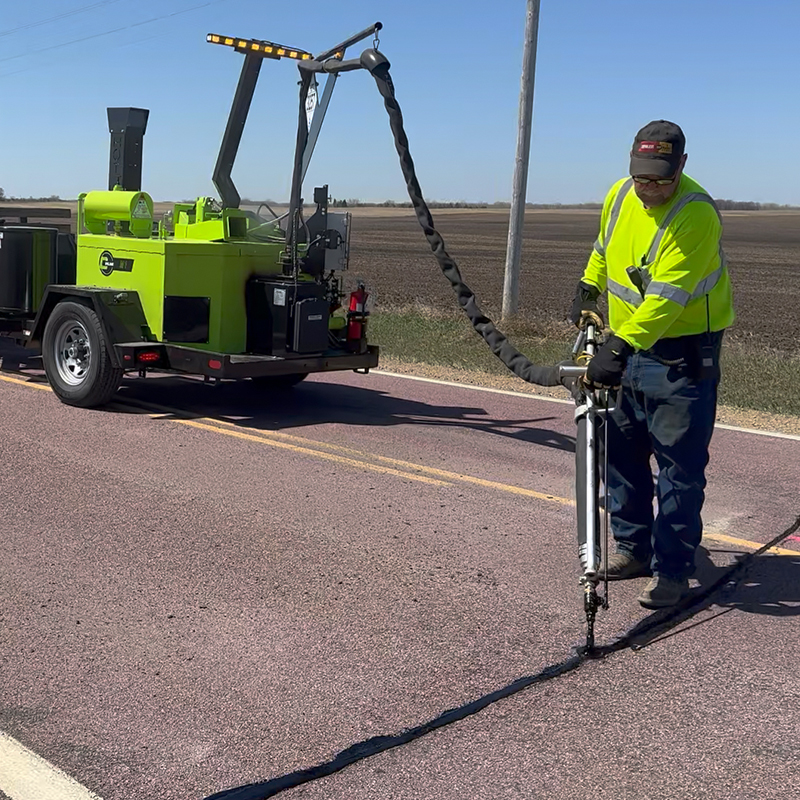
Crack sealing is a preventive treatment. It’s applied before a crack becomes a structural failure. When water infiltrates an asphalt crack, it weakens the base layer beneath the surface, accelerates freeze-thaw damage in cold climates, and allows vegetation to take root along the crack line. Left untreated, a sealed crack that costs a few dollars to fix becomes a pothole that costs orders of magnitude more.
The Cimline M-Series melter applicators are built for this work. Available in three capacity configurations — the M1 at 150 gallons, the M2 at 230 gallons, and the M4 at 410 gallons — the M-Series heats rubberized crack sealant material to the correct application temperature and delivers it precisely into the crack through a heated hose system. The M-Series is known in the industry for quiet operation and a low load height that reduces fatigue for operators working long maintenance routes.
Crack sealing is most effective when applied to cracks that are between one-eighth of an inch and one inch wide, have clearly defined edges, and haven’t yet begun to crumble or show signs of base failure. The pavement surface around the crack should still be structurally sound.
Before sealing, routing the crack with a crack router — like the Cimline R3 — creates clean, uniform walls that allow sealant to bond properly and flex with the pavement through seasonal temperature changes. Routed and sealed cracks consistently outlast saw-cut or unrouted seals.
Use crack sealing when:
- Cracks are present but the surrounding pavement surface is still structurally sound
- Crack width falls between one-eighth and one inch
- Water infiltration prevention is the goal
- The maintenance schedule is proactive rather than reactive
- Budget is focused on extending pavement life before failure occurs
What Is Pothole Patching?
Pothole patching is a corrective treatment. It addresses damage that has already occurred — where pavement has broken apart, base material has eroded or failed, and the road surface is no longer intact. At this stage, sealing is no longer an option. The damaged material needs to be removed and replaced.
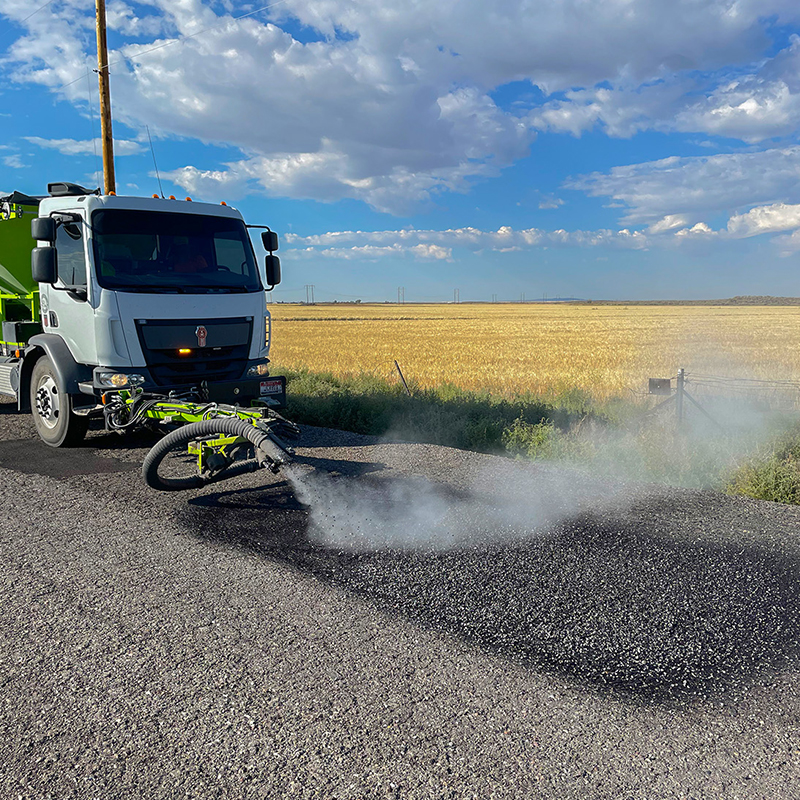
The Cimline DuraPatcher line uses a spray injection process that is fundamentally different from traditional throw-and-roll or cut-and-fill patching. The DuraPatcher blows debris out of the pothole, applies a tack coat of emulsion to the edges and base, injects asphalt aggregate mix into the hole under air pressure, then finishes with a chip seal topping layer. No compaction equipment is required. One or two operators can produce a permanent repair in minutes.
The DuraPatcher lineup includes several configurations for different fleet needs: the P3 truck-mounted unit, the P4 roll-off configuration, and the P5 one-person patcher — each designed to match specific crew sizes and job volumes.
The spray injection method produces repairs that bond to the existing pavement rather than simply sitting in the hole. Independent studies and municipal fleet data consistently show DuraPatcher repairs outlasting traditional patching methods by a significant margin, which reduces the repeat-dispatch cost that drives up the real price of pothole maintenance.
Use pothole patching when:
- Pavement has already broken apart and base material is exposed
- The surrounding pavement surface shows alligatoring, crumbling, or structural failure
- Water has already infiltrated and caused base layer damage
- A crack has widened beyond one inch or begun losing edge integrity
- Safety is an immediate concern and a drivable surface needs to be restored quickly
Side-by-Side Comparison
| Factor | Crack Sealing | Pothole Patching |
|---|---|---|
| Treatment type | Preventive | Corrective |
| When to apply | Before structural failure | After pavement breaks apart |
| Pavement condition | Cracked but structurally sound | Failed surface, exposed base |
| Primary goal | Stop water infiltration | Restore drivable surface |
| Cimline equipment | M-Series M1, M2, M4 | DuraPatcher P3, P4, P5 |
| Crew required | 1 operator | 1–2 operators |
| Compaction needed | No | No (spray injection) |
| Cost per repair | Low | Higher |
| Pavement life impact | Extends life significantly | Restores function, stops further damage |
| Best for budget | Proactive programs | Reactive / emergency situations |
The Lifecycle Problem: Why Timing Is Everything
The biggest driver of pavement maintenance budget waste is mismatched timing. Municipalities that only respond to potholes miss the window when inexpensive crack sealing could have prevented the failure entirely. Crews that try to seal cracked pavement that has already lost structural integrity end up with sealant repairs that fail quickly because the base beneath them isn’t stable.
Pavement engineers widely cite the same cost ratio: one dollar spent on preventive crack sealing saves six to ten dollars in future corrective repair. That math holds because crack sealing protects the base layer. Once the base fails, the cost jumps from a sealing job to an excavation and reconstruction job.
A properly structured pavement maintenance program uses both methods in sequence. Annual crack sealing keeps sound pavement sound. DuraPatcher spray injection corrects the failures that do occur, quickly and permanently, so they don’t spread. Together, the two methods work as a system rather than as separate, reactive responses to individual damage events.
Choosing the Right Cimline Equipment for Your Program
If your crew is building out a pavement maintenance capability or upgrading aging equipment, here’s how the Cimline lineup maps to your program needs.
For crack sealing volume, the right M-Series model depends on how much material your crew burns through in a day. The M2 at 230 gallons is the most popular configuration for municipal road maintenance routes — enough capacity to complete a full day’s work without constant refills, sized appropriately for standard city trucks. The M4 at 410 gallons is the right choice for high-production crews covering large road networks or highway right-of-way. The M1 is a strong entry point for smaller operations or crews adding crack sealing to an existing service mix.
For pothole patching, the DuraPatcher P5 is the one-person production machine that lets a single operator complete repairs without a second crew member handling cleanup or compaction. The P3 truck-mounted unit is built for municipalities running dedicated patching trucks on daily routes. The P4 roll-off configuration gives fleet managers flexibility to move the unit between truck platforms.
Adding the Cimline R3 crack router to the program allows crews to route before sealing, which produces longer-lasting repairs and reduces the total number of re-seal events on any given crack over a pavement’s service life.
Talk to the Haaker Underground Team
Haaker Underground serves municipalities, contractors, and road maintenance operations across California, Nevada, and Arizona with the full Cimline equipment lineup. Our team can help you match the right equipment configuration to your road network, crew size, and annual maintenance budget.
We’re not here to sell you more equipment than you need. We’re here to help you build a program that actually works.
View Cimline Crack Sealing Equipment | See DuraPatcher Models | Contact Our Team
Frequently Asked Questions
What is the difference between crack sealing and pothole patching?
Crack sealing is a preventive treatment applied to asphalt cracks before structural failure occurs. It uses heated rubberized sealant injected into the crack to stop water infiltration. Pothole patching is a corrective treatment applied after the pavement has already broken apart. Cimline’s M-Series melters are used for crack sealing; the DuraPatcher line handles pothole repairs using a spray injection process that requires no compaction equipment.
When is it too late to crack seal?
Crack sealing is no longer effective once the pavement surface has lost structural integrity — when cracks are wider than approximately one inch, the pavement is showing alligatoring or significant crumbling, or the base layer beneath the surface has been compromised by water infiltration. At that point, corrective patching is required to restore the surface before any preventive treatment can be applied.
Does the Cimline DuraPatcher require a compaction roller?
No. The DuraPatcher uses a spray injection process that bonds the patching material to the existing pavement using air pressure and a tack coat of emulsion. The repair is complete without a compaction step, which allows one or two operators to complete a permanent patch in minutes without additional equipment.
Which crack sealing machine is right for a municipal road crew?
The Cimline M2 at 230 gallons is the most common choice for municipal road maintenance. It offers a full day’s material capacity on standard routes without requiring constant refills. For high-volume production work across larger road networks, the M4 at 410 gallons is the better fit. Haaker Underground can help match the right configuration to your specific route length and annual sealing volume.
Can you do crack sealing and pothole patching with the same crew?
Yes, and many municipalities run both programs with the same crew on different days or different seasons. Crack sealing is typically scheduled as a spring or fall preventive operation when temperature conditions are right for sealant adhesion. Pothole patching runs year-round as a reactive program. Cimline equipment supports both workflows within the same fleet.
Haaker Underground serves municipalities, contractors, and industrial operators across California, Nevada, and Arizona with the full Cimline pavement maintenance equipment lineup. Nobody works harder for you.