
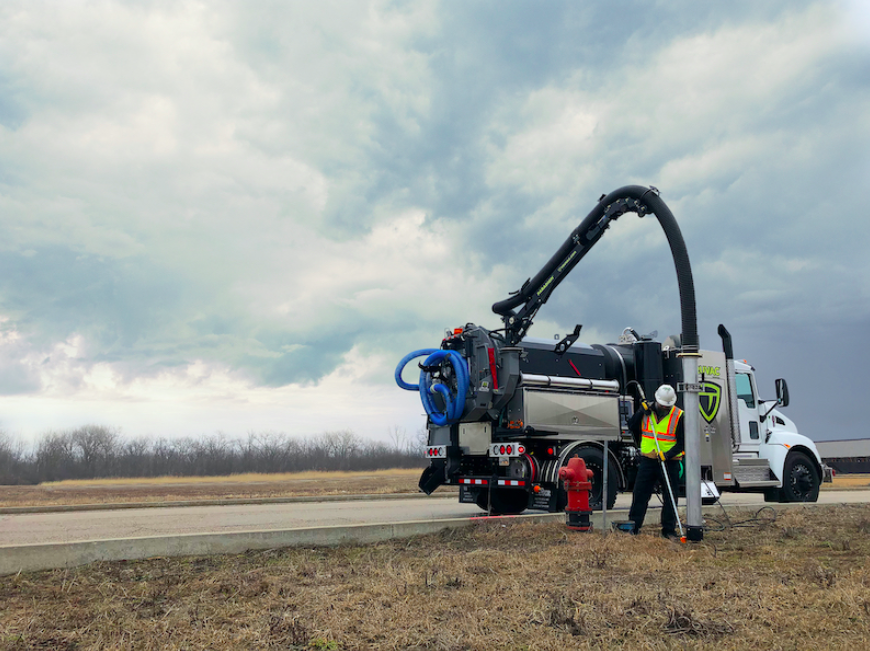
The CDL requirement is one of the quiet cost drivers in vacuum excavation that doesn’t show up on the equipment price tag but shows up every month on the payroll. Most hydrovac trucks gross above 26,000 pounds, which means they require a commercial driver’s license to operate. CDL drivers command a premium wage, and in today’s labor market, finding and retaining them is a real operational challenge for contractors and municipalities alike.
The TRUVAC Paradigm changes that equation. It’s built to Class 6 specifications — which means a standard driver’s license is all your operator needs to get behind the wheel and go to work. No CDL. No endorsements. No waiting for the one driver on your crew who has the right credentials.
For operations that have been priced out of owning a hydrovac by the CDL labor requirement, or that have been limited in how they can deploy hydrovac capability because it’s tied to a single licensed driver, the Paradigm represents a genuinely different kind of equipment purchase. Here’s what it is, what it can do, and why the non-CDL configuration matters more than it might first appear.

What Makes the TRUVAC Paradigm Different
The Paradigm is TRUVAC’s sub-compact vacuum excavator, designed specifically for urban environments, tight access situations, and the CDL-constrained crew deployment model. It’s a complete hydrovac — not a trailer unit or a stripped-down version of a full-size machine — just configured and chassis-mounted in a way that keeps the gross vehicle weight within non-CDL limits.
The practical implication is significant. Any licensed driver on your crew can operate this machine. That means the hydrovac doesn’t sit idle waiting for the CDL driver. It means you can dispatch it with your crew lead, your foreman, or your most experienced operator regardless of their license class. It means you can hire for excavation skill and job knowledge rather than for CDL status.
TRUVAC Paradigm Key Specifications
Chassis Class: Class 6 (non-CDL)
Vacuum System: Positive displacement blower — 15 in/Hg at 2,200 CFM — enough vacuum power to handle standard utility potholing, slot trenching, and daylighting work in a variety of soil types.
Water System: 8 GPM at 2,500 PSI with TRUVAC’s patented DigRight technology. DigRight allows the operator to control water pressure with a single button press, dialing in the right pressure for the material being excavated without manual adjustment. On sensitive utility locating work, lower pressure prevents line damage. On tougher soils, higher pressure is available on demand.
Boom: 6-inch vacuum hose extended to 14 feet, 6 inches with 210-degree rotation. The 210-degree swing arc lets operators position the truck once and dig across a wide work zone without repositioning — critical in tight urban jobsite conditions where repositioning takes time and disrupts traffic flow.
Debris Tank: 675-gallon capacity with a 50-degree tilt for debris disposal. For a non-CDL machine, 675 gallons is substantial — enough for a productive half-day of potholing before an off-load, depending on soil conditions and job scope.
Setup: Park-N-Dig rapid deployment technology. The Paradigm is designed to go from parked to working fast, which matters on urban utility locating jobs where multiple dig sites in a day is the norm.
The CDL Labor Math
A CDL Class A or Class B driver earns roughly $25 to $40 per hour in the California market, with some markets pushing higher for experienced operators. A driver without a CDL but with solid equipment operation skills earns meaningfully less for the same hours behind the wheel.
Across a full-time position, the wage differential between a CDL operator and a non-CDL operator running the same hydrovac route can reach $15,000 to $20,000 per year or more. Over a five-year equipment lifecycle, that differential compounds into a real number.
Beyond the wage difference, the CDL dependency creates a scheduling constraint that has its own cost. When your CDL driver calls in sick, your hydrovac sits. When your CDL driver takes vacation, the Paradigm job gets rescheduled. When your CDL driver leaves for a competitor offering better pay, you’re advertising for a specific license class in a labor market where CDL holders have their choice of opportunities.
The Paradigm doesn’t eliminate the need for skilled operators — experienced, knowledgeable excavation crew members are always the goal. But it removes the CDL gate from the staffing equation, which gives fleet managers and operations managers significantly more flexibility in how they build and deploy their crews.
Where the Paradigm Performs Best
Urban Utility Locating and Potholing
The Paradigm was designed for the tight access conditions that define city infrastructure work. Residential streets, downtown right-of-ways, parking lots, and narrow utility corridors are all environments where the sub-compact chassis and 210-degree boom rotation give it a practical edge over a larger machine. The Park-N-Dig setup technology supports the multi-location, single-day workflow that urban utility locating crews run.
Municipal Infrastructure Programs
For municipalities building out an in-house hydrovac capability, the Paradigm is often the right first machine. It covers the utility maintenance work that public works departments do regularly — water main locates, gas line daylighting, sign post excavation, storm drain inspection prep — without requiring the city to hire a CDL-classified operator position. An existing equipment operator or crew lead with a standard license can run the machine from day one.
Contractor Operations Adding Hydrovac to Their Service Mix
Contractors who have been subcontracting hydrovac work because they couldn’t justify a full-size machine with the CDL staffing requirement attached find the Paradigm changes the math. A production rate that covers the machine cost and the operator’s time without requiring a CDL premium on the labor side makes adding hydrovac to the service mix profitable at a lower utilization rate.
Residential and Light Commercial Projects
Single-family utility locates, residential fiber installation, irrigation system repairs, and pool or foundation excavation near buried utilities all fit the Paradigm’s capabilities and jobsite access profile. The 2,500 PSI water system handles the soil conditions, and the sub-compact chassis fits in access points that would be impossible for a full-size hydrovac.
When to Step Up to a Full-Size Machine
The Paradigm is the right machine for the applications above. It’s not the right machine for everything.
If your crew is running high-volume production excavation on large utility corridors, highway right-of-ways, or industrial facility grounds — where tank size, boom reach, and daily throughput are the key metrics — the TRUVAC HXX with its 12-to-15 cubic yard tank and 22-foot boom delivers what those jobs demand. The trade-off is that the HXX requires a CDL operator, because it’s a full-size production machine on a heavy chassis.
The decision framework is simple: match the machine to the job profile. Tight urban access, multi-location daily routes, and CDL-constrained crew deployments point to the Paradigm. Production excavation on larger scopes points to the HXX or FLXX. Many operations run both — using the Paradigm for the day-to-day utility maintenance work and reserving the larger machine for production contract work.
Talk to the Haaker Underground Team
Haaker Underground carries the full TRUVAC lineup, including the Paradigm, and serves contractors and municipalities across California, Nevada, and Arizona. Our team can walk you through the Paradigm’s specifications in the context of your specific crew size, job types, and CDL situation — and help you determine whether a single Paradigm, a fleet of them, or a combination with a larger TRUVAC model is the right fit for your operation.
View the TRUVAC Paradigm | See the Full TRUVAC Lineup | Contact Our Team
Frequently Asked Questions
Can you run a hydrovac without a CDL?
Yes. The TRUVAC Paradigm is built on a Class 6 chassis, which keeps the gross vehicle weight within the non-CDL threshold. Any operator with a standard driver’s license can legally operate the Paradigm. Most other hydrovac trucks are Class 7 or Class 8 vehicles that require a CDL to operate. The Paradigm is specifically engineered to deliver full hydrovac capability within the non-CDL weight class.
What is the TRUVAC Paradigm’s tank size?
The TRUVAC Paradigm has a 675-gallon debris tank that tilts at 50 degrees for disposal. For a non-CDL compact machine, 675 gallons is a productive capacity for standard utility potholing and locating work, typically supporting a half-day or more of operation before an off-load is needed depending on soil conditions and dig density.
What is DigRight technology on the TRUVAC Paradigm?
DigRight is TRUVAC’s patented water pressure control system. It allows the operator to adjust excavation water pressure with a single button press rather than manual valve adjustments, making it easy to dial in the right pressure for the soil type and the sensitivity of the buried infrastructure being exposed. Lower pressure reduces the risk of utility damage on sensitive locates; higher pressure is available for tougher excavation conditions.
How does the TRUVAC Paradigm compare to the TRUVAC HXX?
The Paradigm is TRUVAC’s sub-compact non-CDL model, optimized for urban utility locating, tight access, and CDL-flexible crew deployment. It runs a 675-gallon tank and a 14.5-foot boom. The HXX is TRUVAC’s full-size production machine with a 12-to-15 cubic yard tank, a 22-foot boom, and 320-degree rotation — built for high-volume production excavation on larger job scopes. The HXX requires a CDL operator. Both are carried by Haaker Underground.
Is the TRUVAC Paradigm available in California?
Yes. Haaker Underground is the authorized TRUVAC dealer serving California, Nevada, and Arizona. The Paradigm is available for purchase, and the Haaker Underground team can support equipment configuration, operator training, and after-sale service across the region.
Haaker Underground serves municipalities, contractors, and industrial operators across California, Nevada, and Arizona with the full TRUVAC vacuum excavation lineup. Nobody works harder for you.