
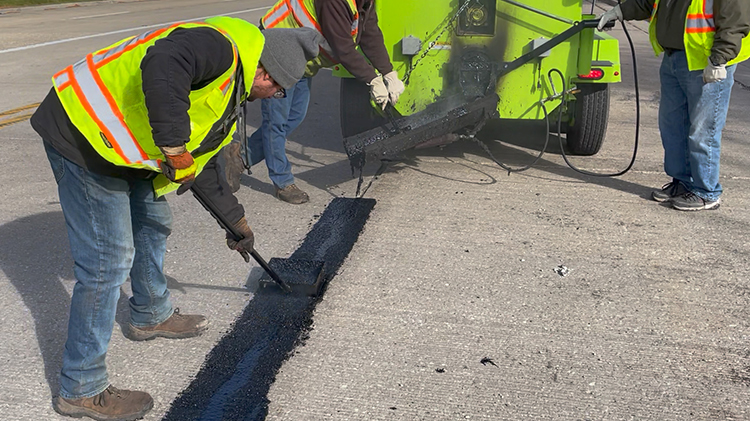
Most pavement maintenance conversations focus on two methods: crack sealing and pothole patching. And those two methods handle the majority of standard road repair work. But there’s a third category of asphalt damage that neither method addresses particularly well — and most maintenance programs either ignore it or handle it with a workaround that doesn’t hold up.
That category is high-stress pavement joints and seams: utility cut edges, bridge deck joints, longitudinal road seams, and other locations where two pavement sections meet, move independently, and take repeated traffic loading. Standard crack sealants flex well in a controlled crack, but they’re not always built for the stress concentrations at joint edges. Pothole patching addresses failures after they occur but doesn’t seal the joint itself. The method designed specifically for this type of repair is mastic, and the Cimline ME-Series Mastic Melters are built to deliver it.
If mastic isn’t part of your pavement maintenance toolkit, here’s what it is, where it performs best, and how to decide when it belongs in your program.
What Is Mastic?
Mastic is a heavy-bodied asphalt repair material that sits between a crack sealant and a structural patch in terms of consistency and application method. It’s thicker and more aggregate-rich than standard rubberized crack sealant, which gives it a higher load-bearing capacity and better performance under traffic stress. Unlike cold-pour sealants, mastic is a hot-applied material that must be heated to the correct application temperature before use — which is exactly what the Cimline ME-Series melters are designed to do.
In practice, mastic behaves more like a flexible structural filler than a surface sealant. Applied to a joint, seam, or transition edge, it bonds to both pavement surfaces and creates a repair that can flex with the joint under traffic loading without cracking or pulling away. The high solids content also makes it resistant to rutting and tracking in hot weather — a real advantage in California, Nevada, and Arizona summer conditions where standard sealants can soften and flow.
Where Mastic Outperforms Standard Crack Sealant
Utility Cut Restoration
Every time a utility crew cuts into asphalt to access buried infrastructure — water lines, gas lines, fiber conduit, electrical runs — the cut edge creates a longitudinal joint between the new patch and the existing pavement. That joint is a stress concentration point. Traffic loading flexes both surfaces differently, and the joint edge is where failure almost always starts.
Standard crack sealant applied to a utility cut edge is a short-term fix. Mastic applied to the same joint creates a repair that handles the differential movement between the patch and the existing pavement and typically lasts far longer between maintenance events. For public works departments managing large volumes of utility restoration, the longer service interval on mastic-repaired cuts reduces the re-dispatch frequency and the total labor cost of the repair program.
Bridge Deck and Expansion Joints
Bridge expansion joints are designed to move. That movement is exactly what defeats standard crack sealants over time — the joint opens and closes with temperature changes and load cycles, and sealants that can’t accommodate that range of motion crack and fail. Mastic’s higher aggregate content and structural body allow it to handle the expansion and contraction of deck joints better than standard products, making it a recognized specification in bridge maintenance programs.
Longitudinal Road Seams
Longitudinal seams — where two paving passes meet along the centerline or lane edge — are among the most common failure initiation points on asphalt roads. The seam is a natural weak point in the pavement structure, and water infiltration along it accelerates base failure rapidly. Mastic applied to longitudinal seams provides both the structural body to handle traffic loading along the seam edge and the waterproofing to stop infiltration before base damage begins.
High-Traffic Intersections and Bus Pads
Pavement at intersections, bus stops, and loading dock aprons takes concentrated braking and turning loads that exceed what most standard road sections experience. These high-stress zones see accelerated deterioration and need repair materials that can hold up under repeated heavy loading. Mastic’s structural characteristics make it a better choice than standard sealants for joint repairs in these environments.
The Cimline ME-Series Mastic Melters
The Cimline ME-Series is available in skid-mounted and towable configurations, with material capacities ranging from 60 to 350 gallons. The range is designed to give maintenance programs the right unit size for their daily work volume — from smaller spot-repair operations to high-production crews covering significant road network mileage.
The ME Bander Applicator is a key attachment for precision mastic application. It applies mastic in a consistent, controlled band width along a joint or seam edge, producing uniform coverage without excess material or irregular application lines. Consistent application width matters because over-application creates a ridge that can cause tire noise and edge cracking, while under-application leaves gaps that allow water infiltration.
Like the M-Series crack sealers, the ME-Series melters are built with operator experience in mind. The heating system maintains material temperature consistently throughout the workday, and the controls are straightforward enough that experienced equipment operators can add mastic work to their skill set without extensive retraining.
Mastic vs. Standard Crack Sealant: When to Choose Each
| Factor | Mastic (ME-Series) | Standard Crack Sealant (M-Series) |
|---|---|---|
| Material consistency | Heavy-bodied, aggregate-rich | Rubberized, flexible sealant |
| Best application | Joints, seams, utility cuts | Standard asphalt cracks |
| Load-bearing capacity | Higher | Standard |
| Bridge / expansion joints | Yes — recommended | Limited |
| Utility cut edges | Yes — preferred | Short-term only |
| Hot weather performance | Rut-resistant | Standard |
| Application method | ME-Series melter + bander | M-Series melter applicator |
| Typical repair interval | Longer — higher durability | Standard service interval |
The two methods are complementary rather than competitive. A complete pavement maintenance program uses M-Series crack sealing for standard asphalt cracks across the road network and ME-Series mastic for the specific joint and seam locations where its structural body is needed. Trying to do the work of mastic with standard sealant is the most common source of repeat calls on utility cut and joint repairs.
Adding Mastic to Your Maintenance Program
If your crew is already running an M-Series crack sealer and DuraPatcher for standard maintenance work, adding ME-Series mastic capability fills the gap in your program for joint and seam repairs. The equipment is straightforward to operate, the material is readily available, and the combination of all three methods — crack sealing, mastic, and spray injection patching — gives your crew the right tool for every type of asphalt damage on your road network.
Haaker Underground carries the full Cimline ME-Series lineup and can help you match unit capacity to your work volume and configure the ME Bander Applicator for your specific joint types and widths.
View Cimline ME-Series Mastic Melters | See the Full Cimline Lineup | Contact Our Team
Frequently Asked Questions
What is mastic asphalt repair?
Mastic is a hot-applied, heavy-bodied asphalt repair material with higher aggregate content than standard rubberized crack sealants. It’s designed for high-stress joint and seam repairs where standard sealants lack the structural body to hold up under traffic loading. Common applications include utility cut edges, bridge expansion joints, longitudinal road seams, and high-traffic intersection joints.
When should I use mastic instead of crack sealant?
Use mastic when the repair location involves differential movement, concentrated traffic stress, or a joint between two pavement sections rather than a simple crack within a continuous pavement surface. Utility cut edges, bridge deck joints, and longitudinal seams are the most common cases where mastic outperforms standard sealant. For standard asphalt cracks across a road surface, the Cimline M-Series crack sealer is the right tool.
What is the Cimline ME-Series Mastic Melter?
The Cimline ME-Series is a line of hot-applied mastic melters available in skid and towable configurations from 60 to 350 gallons. The ME-Series heats mastic material to the correct application temperature and delivers it through the ME Bander Applicator for precise, consistent application along joints, seams, and utility cut edges. Haaker Underground carries the full ME-Series lineup for customers across California, Nevada, and Arizona.
How is mastic different from crack filler?
Standard crack filler is typically a low-viscosity cold-pour or hot-pour material designed to flow into narrow cracks and seal them against water. Mastic is a higher-viscosity, aggregate-rich material that provides structural support in addition to sealing. Mastic holds up under traffic loads and differential movement that would cause standard crack filler to fail relatively quickly at high-stress joint locations.
Does mastic repair require special equipment?
Yes. Mastic is a hot-applied material that must be heated to a specific application temperature before use. The Cimline ME-Series Mastic Melters provide the heating, material holding, and application delivery system required for proper mastic repair. Cold-applied or standard crack sealing equipment is not appropriate for mastic material.
Haaker Underground serves municipalities, contractors, and industrial operators across California, Nevada, and Arizona with the full Cimline